

Mediterrapolis : a european (meta) smart-city

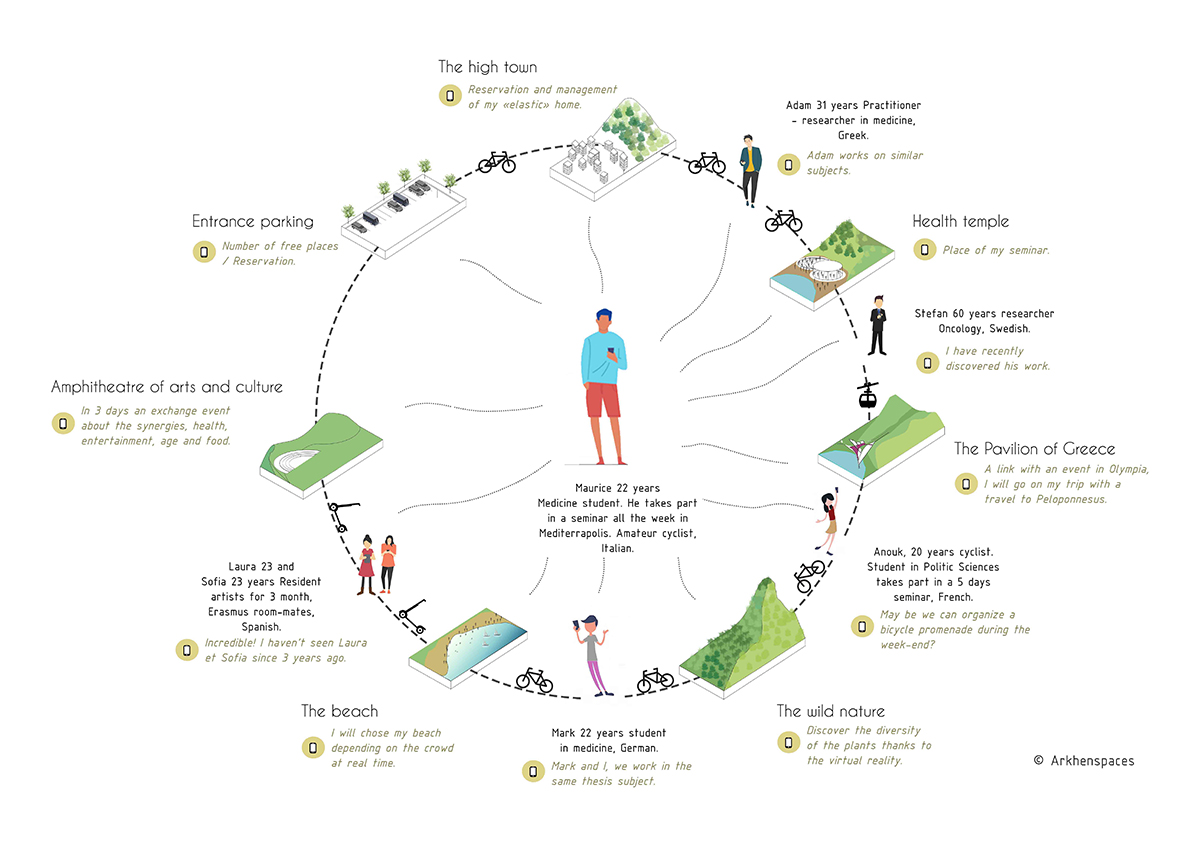
Program Smart-city: European Metacity with mainly temporary residents
Surface 1700 Ha
Location Greece
Schedule Concept initiated in 2017
Client Frédéric Koskas & Ondine Kahyat
Team Eric Cassar, Leire Urionagüena, Alaa Sndyan, Djuneït Lapo
Engineering Artelia
General principles
After building places for Europe’s economic and political dimensions, and in response to the rise of nationalisms, it seems increasingly necessary to build a place for Europeans:
MEDITERRAPOLIS
- A metacity enhancing awareness of European citizenship and inviting visitors to discover the visions and richness of Europe.
- A model of a European Smart-city with mainly temporary residents, where places are conceived as « N-spaces », meaning that their uses transform through space and time and can connect with inhabitants as well as with other physical and virtual environments.
- A place for experiences, reflection, debates and interdisciplinary exchanges in order to look further together and prepare for the future.
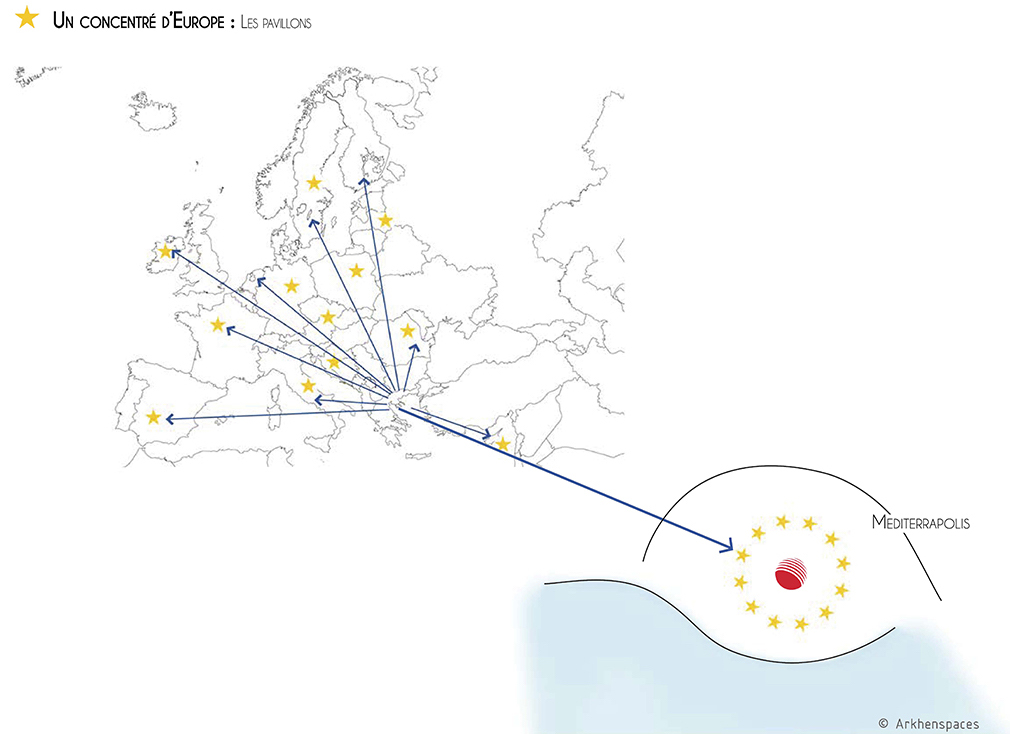
A concentration of Europe: the pavilions
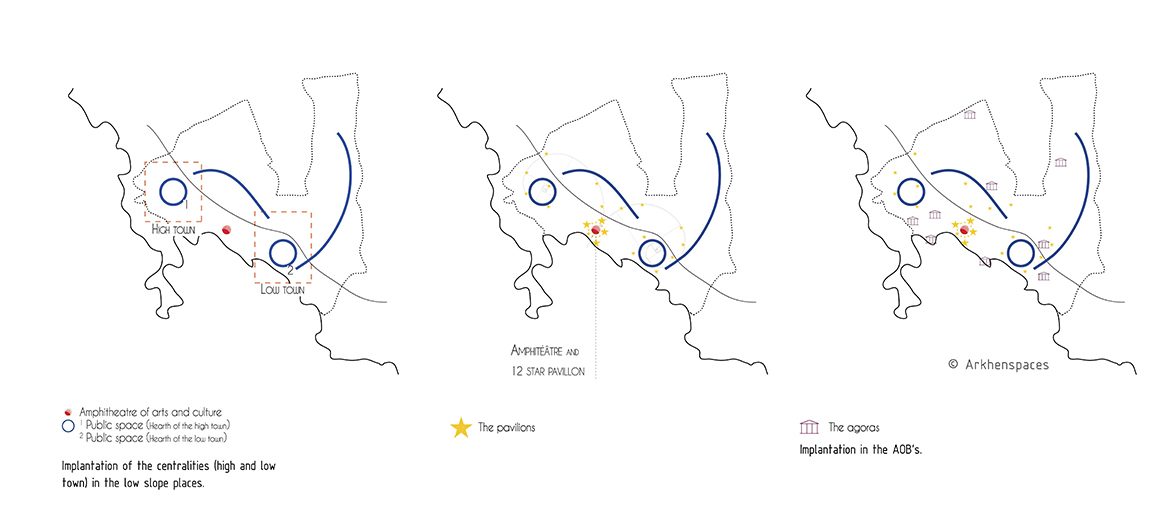
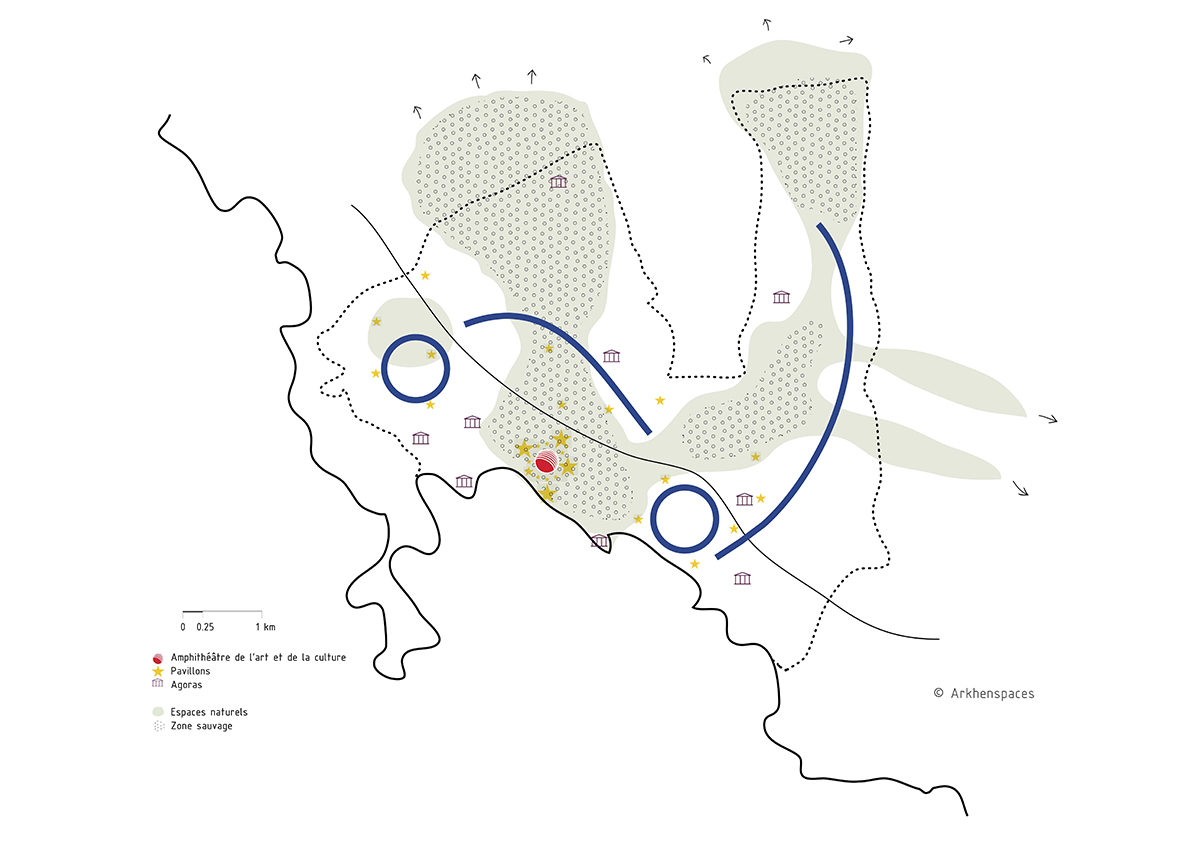
Mediterrapolis is a gateway to different European cultures and countries through 27 star-pavilions accompanied by dedicated spaces (restaurants, shops, etc.).
Digitally connected in real time to their countries of origin, each pavilion becomes a place for events and information highlighting territories, knowledge and know-how, cultures and past, present and future activities specific to each country.
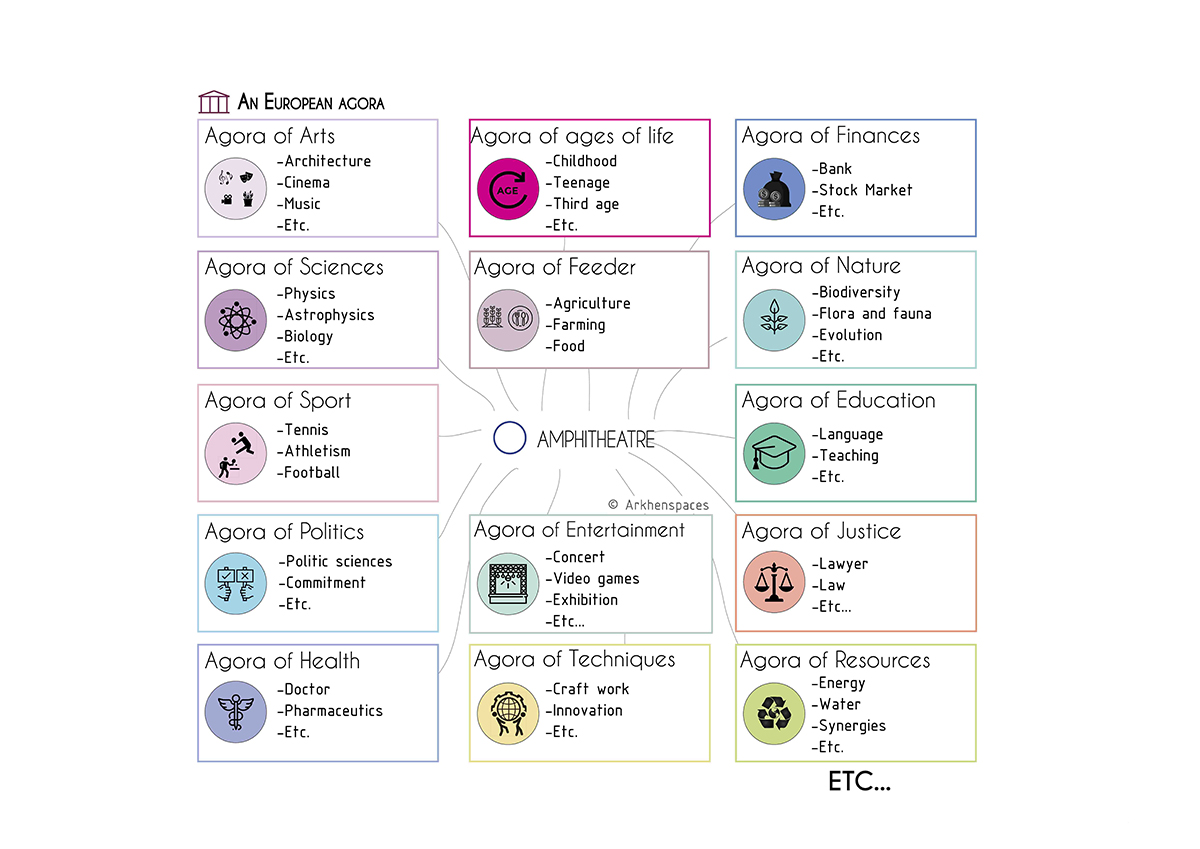
European agoras
Mediterrapolis facilitates the organization of events, experiences and meetings of all kinds around various themes.
To achieve this, it includes around fifteen agoras — « temples » or buildings dedicated to broad themes ranging from sport and health to art, science and politics.
These agoras organize activities and European encounters between specialists, enthusiasts and students around dedicated subjects. They invite discussion, collective questioning and reflection on future challenges. Their geographical proximity encourages interdisciplinary exchange.
A physical space for experience.
For example, the Health Agora may host:
• a conference for hand surgeons
• a seminar for pharmaceutical companies
• educational programs on sleep perception
• an exhibition on sport and health
• a conference for pediatric physiotherapists
• a breathing experience
• etc.
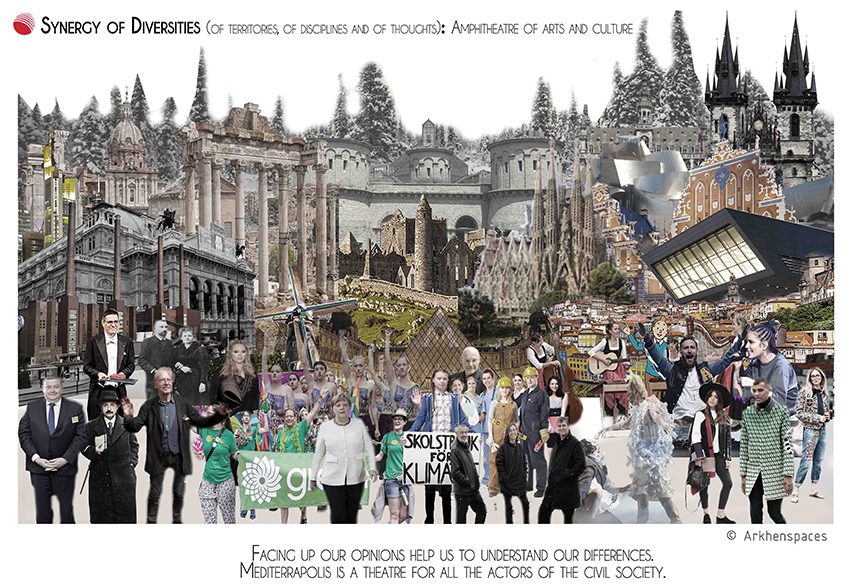
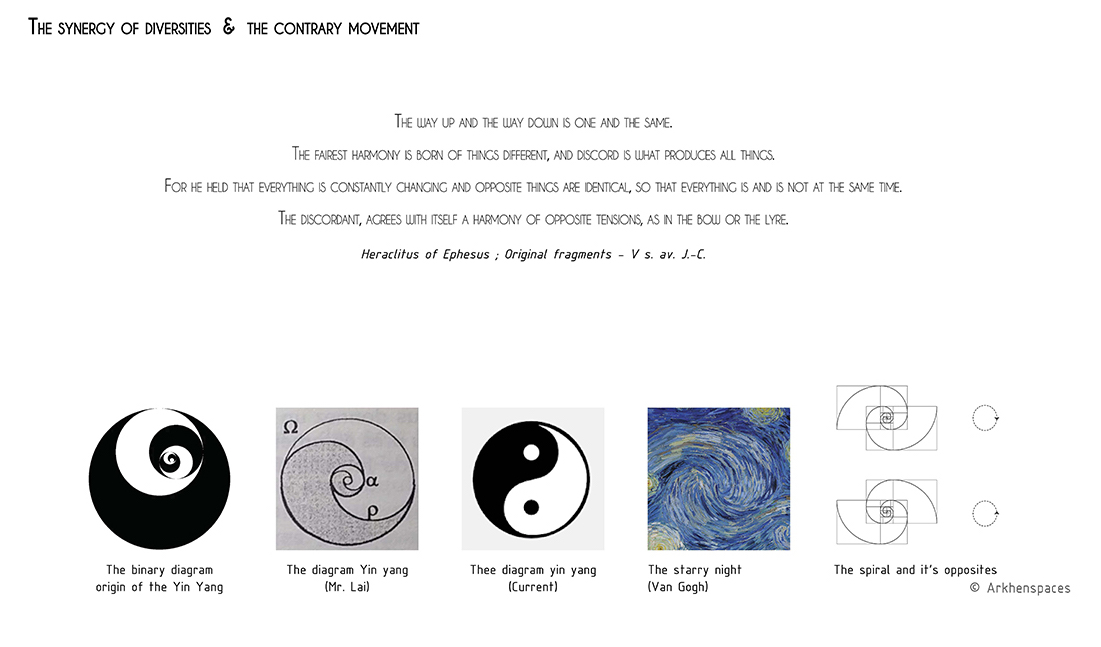
The synergy of diversities (territories, disciplines and ways of thinking)
Mediterrapolis is a metacity with its own space-time, encouraging reflection and collective thinking enriched by our differences and contradictions in order to find the most appropriate solutions.
The amphitheater of arts and culture forms its beating heart.
By confronting our points of view, we learn to better understand our singularities.
Mediterrapolis therefore becomes a stage open to all actors of civil society.
Design principles
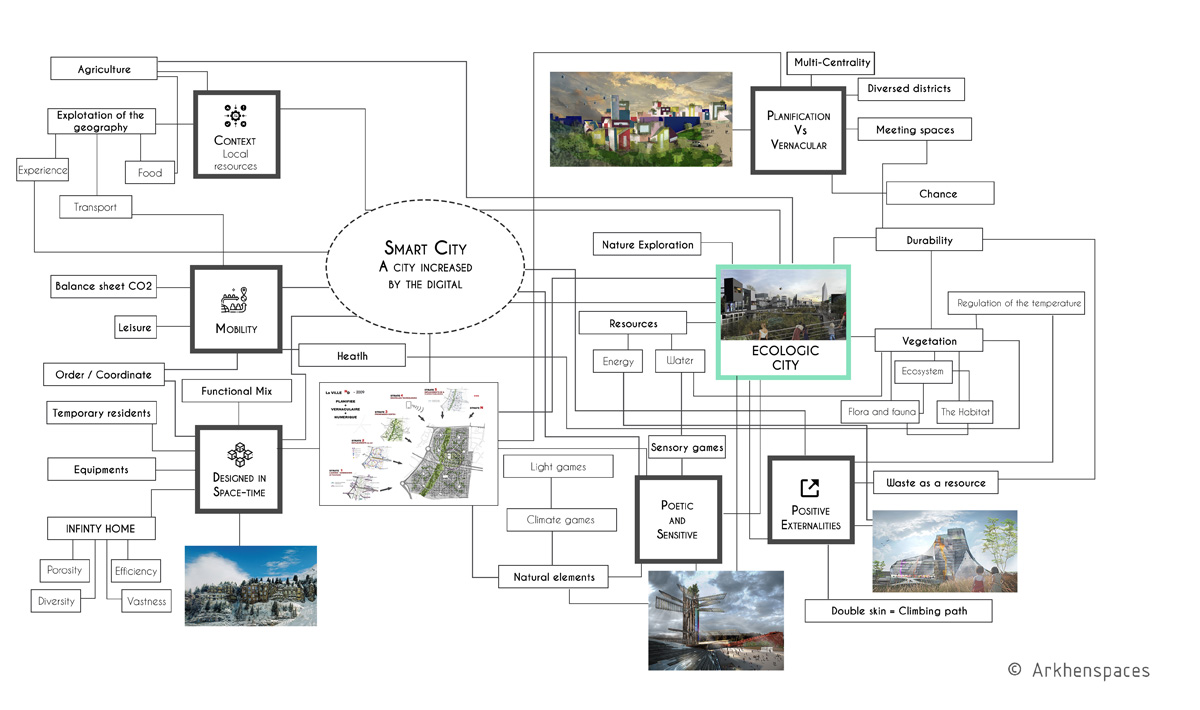
A local and global city, both ecological and poetic, Mediterrapolis takes advantage of synergies to reuse all its resources and generate energy, situations, surprises, meaning and awareness.
Public facilities — schools, sports spaces, theaters, etc. — can host users from different countries for periods ranging from a few weeks to several months.
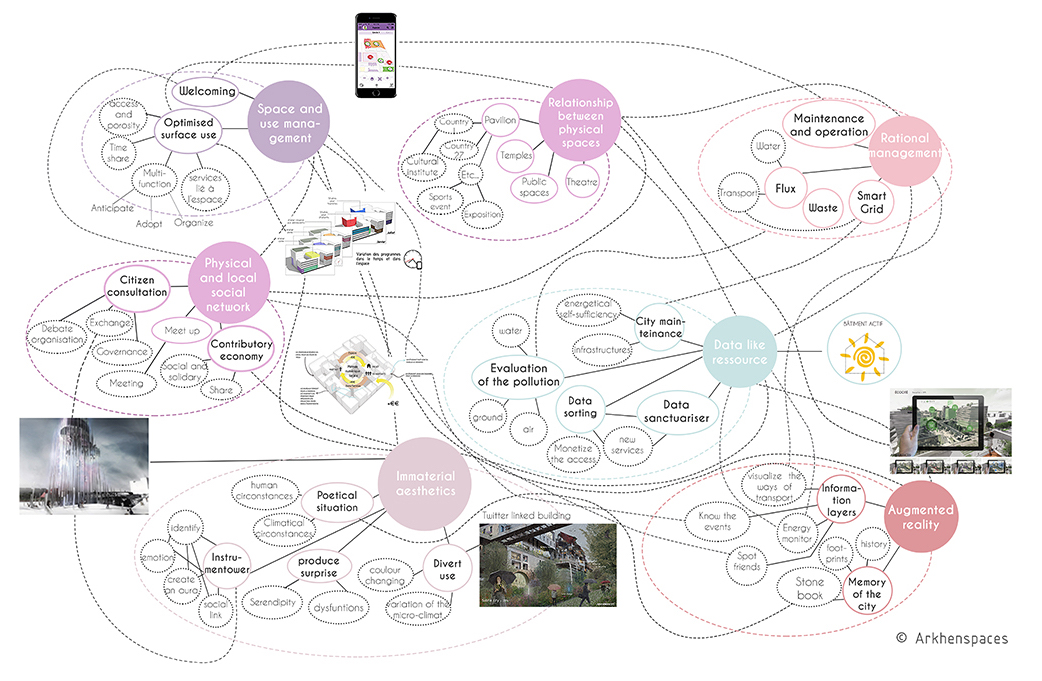
Smart-city: a digitally augmented territory
Digital technologies facilitate exchanges, social relationships and sharing. They encourage chance encounters and provide access to events according to individual interests during one’s stay.
They also enable better management of space-time within the city (maintenance, equipment management and uses): expanding living spaces, multiplying uses and facilitating mobility and the efficient use of spaces.
« Bienveilleurs » — human and digital coordinators or conductors — also support the transformation of spaces through time in order to adapt them to changing needs.
The architect no longer organizes spaces: the architect coordinates space-times.
Mediterrapolis invites Europeans to meet physically, better understand one another and exchange ideas together, enriched by their differences, in order to prepare a better future respectful of the planet, its diversity and ecosystems.
Presentation for Intodays at the Palais des Festivals, Cannes, 2019
A city is where life grows wings.